



Introduction
You take a bite of your favorite meal and there it is again, that small shift under your gum line that tells you the denture just moved. Maybe you have started avoiding corn on the cob, sticky candy, or laughing too hard at dinner because you are not sure your teeth will stay put. That daily guessing game wears people down faster than any dental problem should. Traditional dentures rest on the gums alone, and gums change shape over time, which means the fit you loved a year ago rarely feels the same today. The good news is that dentistry solved this problem decades ago, and the fix does not involve giving up your smile or your grocery list. It involves anchoring your new teeth to something that will not shift under you: your own jawbone.
The Hidden Toll a Slipping Denture Takes
A denture that moves during a meal is not just an inconvenience, it is a full body distraction. People start chewing on one side of the mouth to protect a sore spot, which throws off jaw alignment and can create headaches or jaw fatigue over months of uneven use. Speech gets affected too, since a plate that lifts even a millimeter changes how the tongue hits the roof of the mouth, leading to a lisp or mumbled words that patients often blame on themselves rather than the appliance. Social eating, one of the simple joys of daily life, starts to feel like a performance instead of a pleasure, and many patients quietly stop attending gatherings built around food. None of this is really about vanity. It is about a person's confidence to speak up in a meeting, laugh at a family dinner, or bite into an apple without calculating the risk first.
Anchored Comfort Starts Beneath the Gums
Denture implants work because they change where the pressure of chewing actually lands. Instead of resting entirely on soft tissue, the replacement teeth connect to small titanium posts placed directly into the jawbone, so biting force travels into bone rather than gum. This single change explains almost every comfort improvement patients report after switching.
What Happens Underneath the Surface
Once a post is placed, the bone around it begins to grow tight against the titanium in a process dentists call osseointegration. This is the same biological reaction that lets a natural tooth root hold firm for a lifetime, and it is why an anchored denture feels closer to real teeth than anything resting on the gums ever could.
Patients often describe the difference in a single sentence: they simply stop thinking about their teeth. No more checking with the tongue between bites, no more avoiding certain foods, no more carrying adhesive in a purse or glove box just in case. The mouth starts to feel like a normal part of the body again instead of a device that needs constant management.
Signs You Might Be a Candidate for Implants
Not every denture wearer needs implants right away, but certain patterns are strong signals worth a conversation with a denturist. If any of the following sound familiar, it is worth asking about your options during a consultation.
- Your denture needs adhesive reapplied more than once a day
- You avoid firm or chewy foods out of fear the plate will move
- Friends or family have mentioned your speech sounds different since getting dentures
- You have noticed your face looking more sunken around the mouth and cheeks
- Sore spots keep returning even after multiple adjustments
If you recognize two or more of these, your jawbone and gum tissue may already be telling you it is time for a firmer foundation. A short exam can usually confirm whether implants make sense for your specific mouth and budget.
Bone Health and the Numbers Behind It
Nationally, about 15 percent of seniors aged 65 and older have no remaining natural teeth, according to the National Institute of Dental and Craniofacial Research's data on tooth loss in seniors. That is a large population relying on some form of denture, and it is exactly the group most affected by what happens to bone once teeth are gone. Chewing forces normally travel through tooth roots into the jaw, and that steady pressure is what keeps bone dense and full over the years.
Once teeth are missing, that stimulation disappears, and the body slowly reabsorbs bone that no longer has a job to do. Traditional dentures cannot reverse this because they sit on the gum rather than the bone itself. According to the Cleveland Clinic's overview of implant supported dentures, this style of denture attaches directly to implants placed in the jawbone instead of resting on top of the gums, which is why patients experience far less shifting, slipping, or wobbling while chewing, eating, or speaking. That direct connection is the mechanical reason implants hold steady where a traditional plate eventually will not.
Life With a Denture That Actually Stays Put
The daily experience of wearing implant anchored dentures tends to surprise people who assumed all dentures felt the same. Once healing is complete, most patients describe eating and speaking as close to effortless in the sense that they simply stop noticing their teeth during normal activity.
- Eating steak, corn, apples, and other foods that once felt risky
- Speaking clearly without a plate shifting mid sentence
- Laughing, sneezing, or yawning without worrying the denture will move
- Spending less on adhesive and denture cleaning products over time
- Sleeping without discomfort from a loose plate rubbing sore gums
Patients who make the switch rarely look back, mostly because the change is not cosmetic, it is functional. A mouth that works the way it is supposed to changes how a person eats, talks, and shows up in daily life.
Who Tends to Notice the Biggest Difference
Patients coming from a full lower denture usually report the largest improvement, since the lower jaw naturally has less surface area for suction and stability than the upper jaw. Anyone who has struggled specifically with a bottom plate moving during meals is often the best candidate to feel an immediate difference after switching to an implant supported option.
Choosing New Smile Dentures for Your Implant Plan
New Smile Dentures has spent more than 60 years across three generations helping people in Caldwell and Boise get their bite back without the runaround. Our in house lab means your new teeth are built and adjusted close to home instead of shipped off to a factory somewhere else, and our team walks you through every option, from a full implant supported set to a simpler repair, based on what your mouth and your budget actually need. If a slipping denture has been quietly running your life, a free consultation is the first step toward denture implants that finally stay where you put them.
Frequently Asked Questions (FAQs)
1. How long does it take to get denture implants?
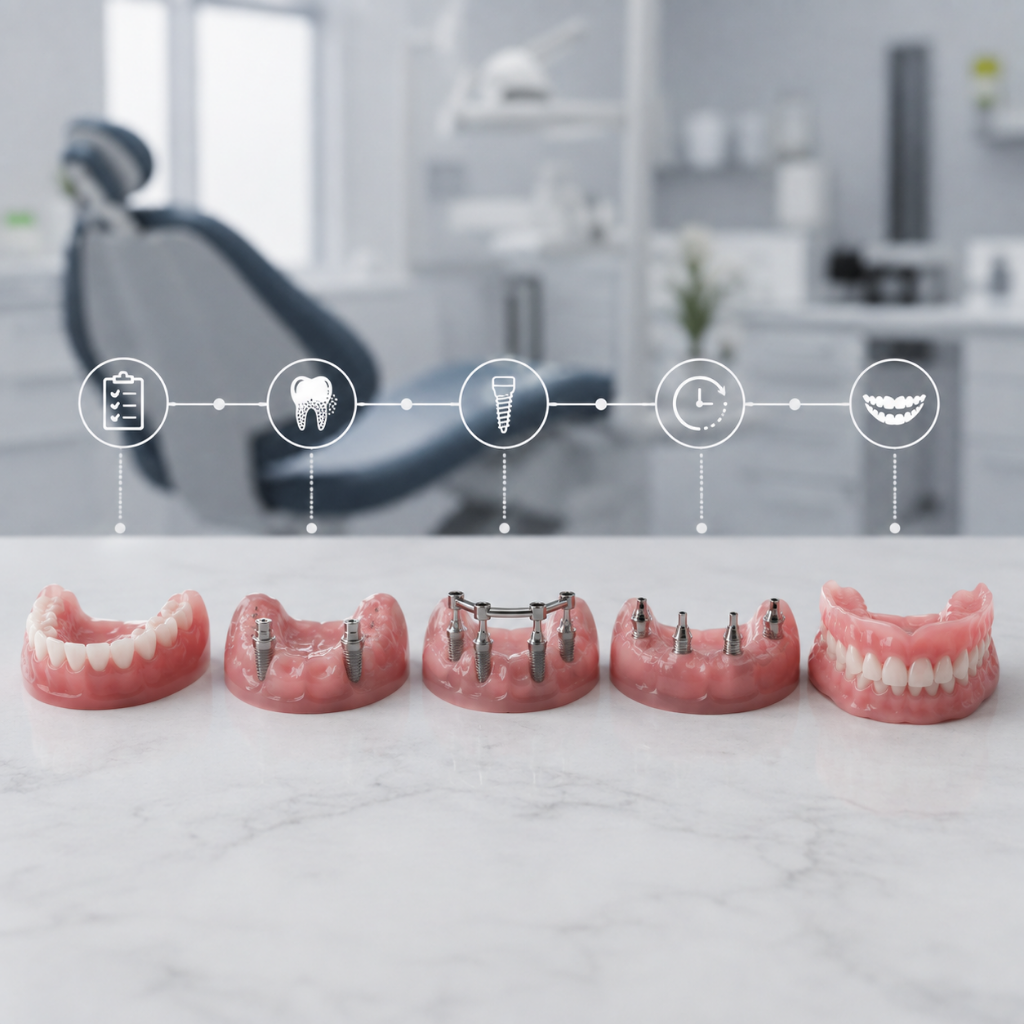
Most patients complete the full process, from placement to final fitting, within three to six months depending on healing.
2. Do denture implants hurt during placement?
Local anesthesia is used during placement, so patients typically report only mild soreness for a few days afterward.
3. Can I switch from a traditional denture to an implant supported denture?
Yes, most traditional denture wearers with adequate jawbone can transition to denture implants after an exam confirms candidacy.
4. How much do denture implants cost at New Smile Dentures?
Pricing depends on the number of implants and the type of denture chosen, and our team will walk you through exact numbers during your free consultation.
5. Will insurance or Medicaid help cover the cost?
New Smile Dentures accepts several insurance plans and is a Medicaid provider through MCNA Dental Idaho, and we also offer in house financing starting around $75 a month.