

.png)


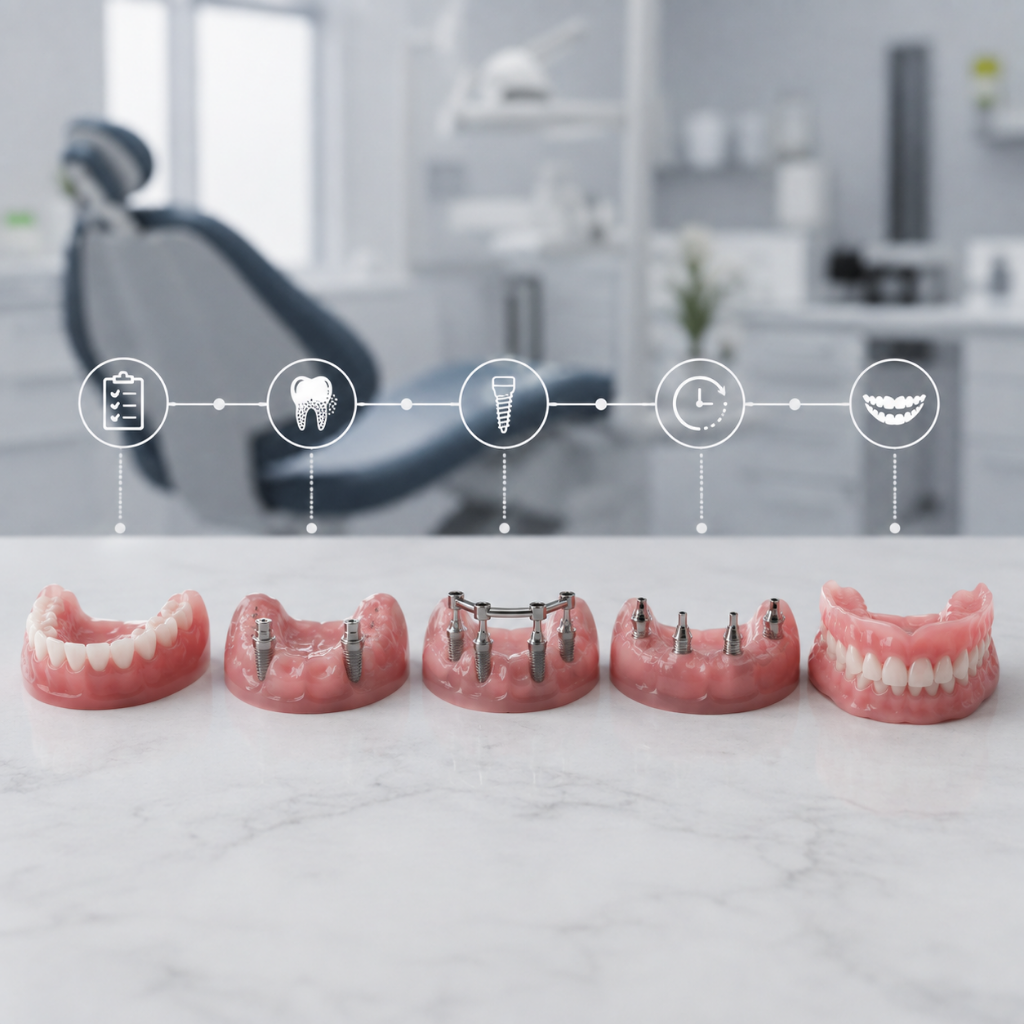
"How long is this actually going to take?" is often one of the first practical questions people ask after deciding that implant-supported dentures may be right for them. It is a reasonable question, but there is no single timeline that fits every patient.
Unlike traditional dentures, implant supported treatment involves surgery and a period of healing before the final restoration can be placed. Some patients move through the process in several months, while others need additional treatment that makes the timeline longer. The deciding factors usually include the condition of the jawbone, whether teeth need to be removed, whether bone grafting is necessary, and how the implants heal.
Understanding each stage makes the process easier to follow and gives patients a more realistic idea of what happens between the first consultation and the final denture.
Step 1: Consultation and Treatment Planning
The process begins with a detailed evaluation of your oral health and treatment goals. Your provider may review your dental history, examine your gums and remaining teeth, and use dental imaging to assess the jawbone and determine whether there is enough bone available for implant placement.
Your bite and the position of the proposed implants also need to be considered because they influence how the final prosthesis will function. New Smile Dentures describes its denture process as beginning with consultation, impressions, jaw measurements, a diagnostic test fit, and final fitting. The exact sequence for an implant supported case can vary because surgical planning may involve additional imaging and coordination with the implant provider.
For some patients, the planning stage can be completed relatively quickly. Others may require additional visits before the surgical and restorative phases can begin.
Step 2: Extractions and Bone Grafting, If Needed
If damaged or non restorable teeth must be removed, the timing of implant placement depends on the condition of the extraction sites and the treatment plan. In selected cases, an implant may be placed at the time of extraction. In other cases, healing is allowed to progress before implant placement.
Bone grafting is another variable. If the jaw does not have enough bone volume or density for the planned implants, grafting may be recommended before implant surgery. The purpose is to build a stronger bone foundation for implant placement.
According to the Cleveland Clinic's overview of dental bone graft healing, initial recovery takes about a week, but the graft itself needs at least three months to heal. Larger grafts may require nine to 12 months before they are ready for the next stage.
Not every patient needs a graft. For someone with adequate bone, skipping this stage can remove several months from the overall process.
Step 3: Implant Placement
Once the jaw is ready, the dental implants are surgically placed into the bone. The number of implants depends on the treatment design and the type of denture being supported.
The surgical appointment itself may be relatively short compared with the healing period that follows. After placement, it is normal to experience some soreness, swelling, or tenderness around the surgical sites. Your provider will give specific instructions for eating, cleaning, activity, and medication during this early recovery period.
A temporary denture or temporary restoration may be used during healing when appropriate. Whether one is provided depends on the treatment plan, the patient's condition, and the type of restoration being used.
Step 4: Osseointegration and the Final Restoration
This is usually the longest part of implant treatment. After placement, the implants need time to integrate with the surrounding jawbone through a process called osseointegration. This biological process creates the foundation needed to support the final restoration.
According to the Cleveland Clinic's overview of dental implants, osseointegration can take approximately three to nine months, depending on how quickly the individual heals. Once healing is complete, the abutment and final restoration can be attached.
This explains why implant treatment cannot always be completed on a fixed schedule. The surgical appointment may be completed in one day, but the biology of healing determines when the next stage is appropriate.
Step 5: Fitting and Adjusting Your New Denture
Once the implants have healed and the final restoration is ready, the denture is fitted and checked for comfort, bite, and function. This stage can include adjustments to make sure the restoration works properly during eating and speaking.
Even implant supported dentures require an adjustment period. The prosthesis may feel different from a conventional denture because the way it is supported has changed. Patients may need some time to become accustomed to the new bite and the feel of the restoration.
For more detail about the eating and speaking stage, our guide to eating and speaking with new dentures explains common early experiences and signs that an adjustment may be needed.
So, How Long Does the Whole Process Actually Take?
There is no universal timeline for denture implants.
A patient who already has sufficient bone and does not require additional procedures may move from treatment planning to final restoration in several months. Much of that time may be devoted to implant healing rather than active appointments.
For patients who need extractions or bone grafting, the process can take longer. A graft may require several months of healing before implant placement, and the implants themselves may then require another three to nine months for osseointegration.
This means that an uncomplicated case and a case involving substantial bone rebuilding can have very different timelines. The best estimate comes after imaging and treatment planning have established which stages are actually required.
What Actually Determines Your Timeline
Several factors can influence how quickly treatment progresses. Bone volume is one of the biggest because it affects whether grafting is needed before implant placement. Healing rate also varies from person to person.
Smoking and certain health conditions can affect healing, so your provider will review your medical history before surgery. The number and location of implants, extraction requirements, the type of final restoration, and the condition of the gums can also affect scheduling.
Just as important is the distinction between treatment time and healing time. Some stages involve an appointment that lasts a relatively short period, while others require weeks or months of biological healing.
The most useful next step is to establish which stages apply to your case. A consultation can help clarify whether you are likely to need extractions, bone grafting, implant placement, and a separate healing period before your final denture is fitted.
Conclusion
The implant denture process is best understood as a series of clinical stages rather than a single appointment with a fixed finish date. The biggest variables are usually bone condition, the need for grafting or extractions, implant healing, and the type of final restoration.
For some patients, treatment may take only several months. Others may need considerably longer because additional bone treatment or healing time is required. Understanding those variables in advance makes the process easier to plan and helps set expectations around appointments, temporary restorations, and final fitting.
The important point is that the timeline is driven by your oral condition and healing response, not simply by laboratory production time. A careful assessment at the beginning provides the clearest picture of what your individual treatment path may look like.