

.png)


What Are Partial Dentures and How Do They Work?
Losing a few teeth does more than just change your reflection; it changes how you move through the world. You might find yourself chewing gingerly on one side or subconsciously shielding your mouth during a conversation. It’s a quiet, nagging stress that turns every meal into a tactical mission and every photo into a reason to feel shy.
When those empty spaces are left open, your remaining teeth lose their "neighbors" and start to wander, tilting into the gaps and throwing your entire bite off balance. This shift can lead to nagging jaw pain and a smile that feels increasingly foreign. You deserve to eat what you want and speak with total certainty again.
The good news? Modern dental prosthetics have come a long way from the clunky, obvious plates of the past. These sleek, custom-fitted pieces act like the missing link for your mouth, bracing your existing teeth while filling the void with a natural look.
Let’s explore the mechanics behind these dental solutions and see how they actually stay put while you go about your day.
The Biological Concept of Removable Partials
A partial denture is a removable dental appliance designed for people who still have some of their natural teeth but are struggling with localized gaps. Instead of a full plate that covers the entire roof or floor of the mouth, a partial is a targeted solution. It consists of artificial teeth attached to a base that mimics the appearance of your gums. This base is often reinforced by a hidden framework, acting as a sturdy bridge that links your remaining teeth together. The core purpose is to restore the "arch integrity" of your mouth, ensuring that every time you close your jaw, there is a solid surface there to meet the pressure.
The Mechanical Grip: How Partials Stay Secure
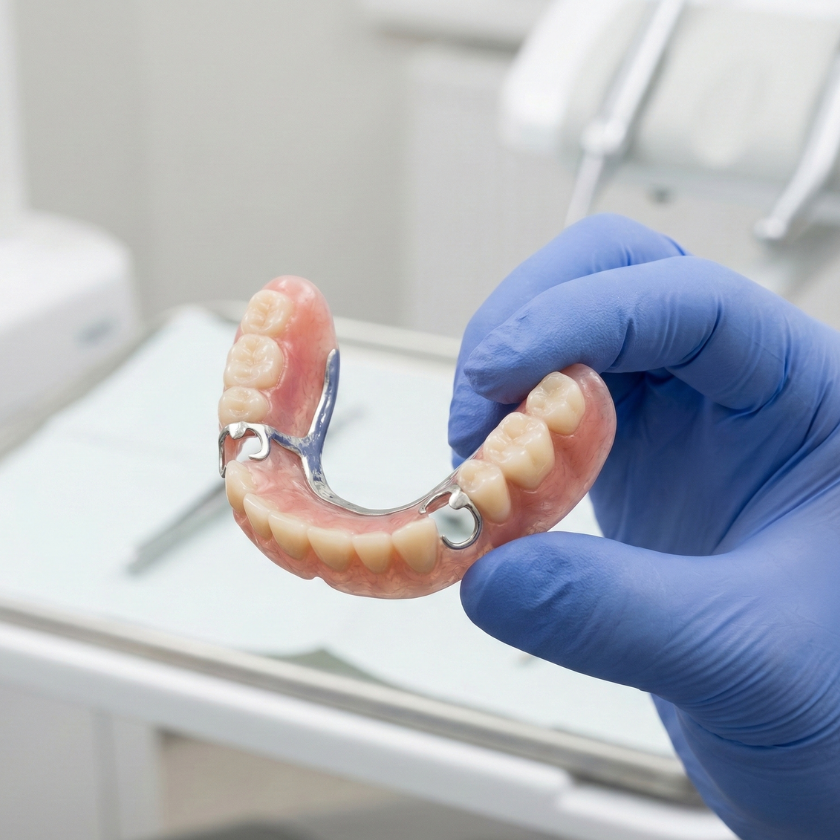
The way these devices function is a blend of physics and clever engineering. Most partials stay in place using abutment teeth, your healthy, natural teeth that serve as anchors. Small clips or attachments, made of either medical-grade alloy or a tooth-colored resin, wrap around these anchors to create a firm, snap-in fit. This ensures the prosthetic doesn't shift when you are mid-sentence or enjoying a meal.
Beyond the hardware, the prosthetic is shaped to follow the specific topography of your gum line. This creates a natural seal that works with the moisture in your mouth to provide a light suction. By combining this surface tension with the mechanical grip of the clasps, the device becomes a stable platform for chewing. It doesn't just sit in the mouth; it integrates into the existing dental landscape to function as a unified unit.
Research from the National Institutes of Health indicates that partial dentures help maintain the vertical dimension of the face. This means they prevent the lower half of the face from collapsing, a common side effect of tooth loss that leads to premature wrinkles around the mouth.
Materials That Drive Daily Performance
- Cobalt-Chrome Frameworks: These are the heavy-hitters of the dental world. They are incredibly thin but offer the highest level of strength, making them feel less bulky while providing a rock-solid bite.
- Thermoplastic Polyamides: Often known for their flexibility, these materials are perfect for patients who want a prosthetic that moves with them. They lack metal clips, making them virtually invisible.
- High-Impact Acrylics: This is the pink material that looks like gum tissue. It is designed to be non-porous, meaning it won't soak up stains or odors as long as it is rinsed regularly.
- Composite Resin Teeth: The actual teeth are layered with different shades to mimic the way natural enamel reflects light, ensuring the prosthetic doesn't look like a one-size-fits-all plastic strip.
How Partials Protect Your Remaining Smile?
Balancing the Chewing Workload
The primary way of a partial is its ability to redistribute force. When you have missing teeth, your remaining ones have to work twice as hard to grind down food. This leads to cracks and premature wear. A partial takes over that burden, spreading the pressure of every bite across the entire jawbone.
Stopping the Dental Drift
Teeth are social; they like to have neighbors. When a tooth is lost, the ones next to it will eventually start to tilt or lean into the open space. This "drift" ruins your bite alignment. The partial acts as a bulkhead, physically blocking your natural teeth from moving and keeping your smile straight.
Supporting the Jawbone Density
When you chew, the roots of your teeth stimulate the jawbone, telling the body to keep that bone thick and healthy. A partial mimics this stimulation by putting "functional load" on the ridges of your gums. This helps slow down the bone loss that typically follows tooth loss, preserving your facial structure.
The Step-by-Step Way Your New Teeth Function
The journey of a partial denture begins with a master blueprint of your mouth. A dental professional takes a detailed 3D impression that captures every peak and valley of your gums. This ensures that the base of the prosthetic sits perfectly flush against your tissue, preventing food particles from getting trapped underneath.
The Science of Jaw Calibration
This stage is all about "the bite." A technician uses a device called an articulator to mimic how your jaw moves up, down, and side-to-side. The goal is to ensure the artificial teeth hit at the same time as your natural ones. If the alignment is off by even a hair, it can cause jaw pain, so this calibration is the most vital part of the build process.
Sustaining Long-Term Oral Health and Stability
Once the final piece is fitted, it functions as a protective shield for your entire mouth. Filling the gaps, it prevents the cheeks from "sinking in," which maintains the youthful volume of your face. Because modern materials are designed to be biocompatible, the prosthetic doesn't irritate the gums; instead, it provides a comfortable cushion that allows you to eat a diverse diet of proteins, fruits, and vegetables again.
- Speech Correction: Missing teeth often cause air to escape when saying "S" or "T" sounds. The partial provides the necessary surface for the tongue to strike, restoring clear speech instantly.
- Hygiene Access: Since the device is removable, you can maintain a high level of cleanliness for your remaining natural teeth, reducing the risk of decay in the anchor spots.
- Future-Proofing: Many partials are designed so that if you lose another tooth in the future, a new artificial one can often be added to the existing frame, saving you from needing a whole new prosthetic.
By acting as both a cosmetic filler and a functional tool, the partial denture bridges the gap between losing your teeth and losing your lifestyle. It provides the stability you need to stop worrying about your mouth and start focusing on the people and meals in front of you.
Final Thoughts
Deciding to mend the gaps in your smile is a powerful pivot from simply getting by to truly thriving in your skin. Once you grasp what partial dentures are and how they work, the mystery fades, and you realize these aren't just plastic plates; they are structural reinforcements for your entire facial identity. This specialized hardware stops the silent migration of your healthy teeth and restores the biological balance your jaw needs to stay strong. You deserve the freedom to order anything off a menu and the poise to speak up in a crowded room without a second thought. Investing in a custom fit today is the ultimate insurance policy for your future dental health and personal peace of mind.
The window to stabilize your bite is closing as your natural teeth slowly drift. Don't let a temporary gap become a permanent disaster. Reach out to New Smile Dentures this second to secure your priority evaluation and lock in the confident, functional life you’ve been missing.
Frequently Asked Questions (FAQs)
1. How exactly do these plates stay in place during a meal?
They utilize discreet, tension-based anchors that grip your sturdy natural teeth to create a rock-solid foundation that won't budge.
2. Can I expect my speech to change after getting a partial?
While there is a brief adjustment period, the prosthetic actually helps fix lisps by providing a solid wall for your tongue to strike.
3. Is it difficult to keep the hardware clean daily?
Maintaining your new smile is as simple as a quick rinse and a soak, allowing you to keep your mouth fresh without any hassle.
4. Will my remaining natural teeth be damaged by the metal clips?
When professionally fitted, the clips distribute pressure evenly to protect your enamel and prevent the "drifting" that causes real dental damage.
5. Are there financing options if I don't have traditional insurance?
We provide flexible in-house payment plans starting at $75 a month to ensure that a complete smile is accessible for every budget.