


.png)


Partial Dentures vs Bridges: Which Is Better?
You're missing a tooth or a few. You've done some searching. Two options keep showing up: partial dentures and dental bridges. Everyone has an opinion. Your dentist mentioned both. The internet gave you ten conflicting answers.
Here's the thing nobody tells you upfront: there is no single "better" option. There's only the one that fits your mouth, your habits, and the current condition of your remaining teeth. Pick the wrong one, and you'll feel it every time you eat, every time you smile, and every time you sit in the dental chair getting something adjusted that never quite felt right from the start.
This guide cuts through the noise. No filler, no vague comparisons, just a clear, honest breakdown of how each option works, what living with each one actually looks like, and the exact situations where one wins over the other.
What a Partial Denture Is and What It Asks of You
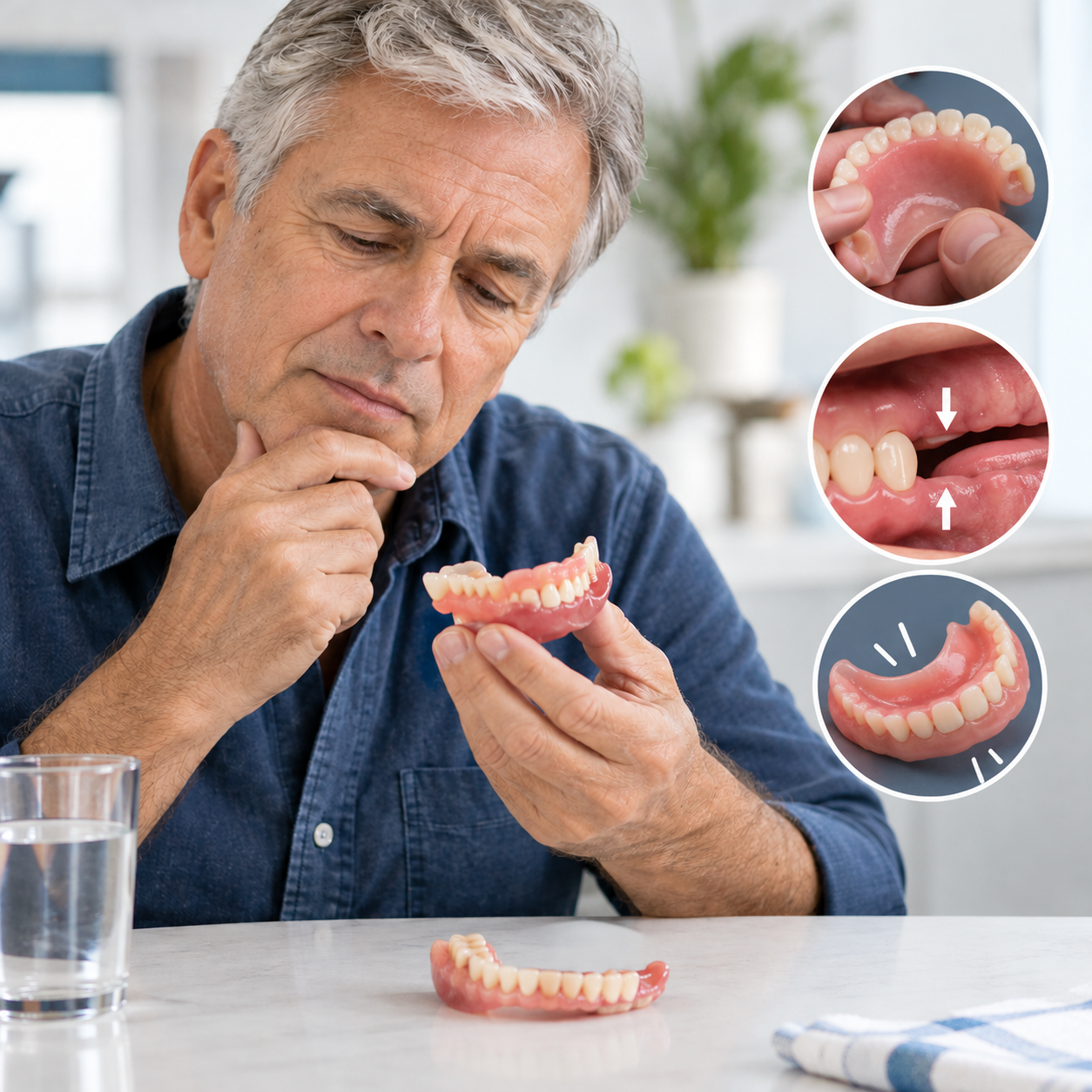
A partial denture is a removable appliance. It clips onto your remaining natural teeth using metal clasps or precision attachments, fills the gaps left by missing teeth, and comes out every night for cleaning. The base is typically acrylic or cast metal, with artificial teeth built into it to match the spaces in your mouth.
The Real Advantage Nobody Talks About
Partial dentures can replace teeth that are scattered in different areas of the same arch, something a bridge cannot do. One appliance can address multiple gaps at once, making it a genuinely flexible solution for patients whose tooth loss doesn't follow a neat, consecutive pattern.
They also require zero permanent changes to your healthy remaining teeth. No enamel gets removed. No healthy tooth gets reshaped. If your gum health is a concern or your remaining teeth aren't strong enough to anchor a bridge, a partial denture works around those limitations rather than depending on them.
The daily routine does ask more of you, removal every night, soaking, separate cleaning before reinsertion each morning. For patients who are disciplined about dental habits, this is a non-issue. For patients who know they'll struggle with a multi-step daily routine, it's worth thinking hard about before committing.
What a Dental Bridge Is and What It Permanently Changes
A dental bridge is a fixed appliance. Once it's in, it stays in. It spans the gap left by missing teeth by anchoring artificial replacement teeth called pontics between two crowns cemented onto the natural teeth on either side of the gap. You eat with it, sleep with it, and clean around it just like your natural teeth.
The Trade-Off That Catches Patients Off Guard
Most patients don't fully understand this part before committing: getting a bridge permanently alters healthy teeth that may have never had a single problem. According to the Cleveland Clinic's overview of dental bridges, placing a traditional bridge requires reshaping the abutment teeth by removing enamel so the crowns can fit over them, and this step cannot be undone. Those teeth will require crowns for the rest of your life, regardless of what happens to the bridge later.
That's not a dealbreaker; it's just something every patient deserves to know before they say yes. For the right candidate, a bridge delivers a level of stability and natural daily function that a partial denture doesn't fully match.

Lifespan: How Long Each Option Actually Lasts
This is where the two options separate most clearly.
Dental bridges, when properly cared for, typically last between ten and fifteen years. Some go longer. The key variable is the health of the supporting teeth. If those teeth develop decay or gum disease after placement, the entire bridge is at risk, well before its expected lifespan runs out.
Partial dentures have a shorter window. According to the Cleveland Clinic's clinical guidance on dentures, the average lifespan of a denture is seven to ten years with proper care, and most patients need a reline every one to two years as their jaw and gum tissue continue to shift over time. The material matters too: cast metal frameworks hold up longer than acrylic-only bases, but wear is inevitable either way.
Neither option lasts forever. The question is which one suits the next ten to fifteen years of your life and which one you'll actually maintain well enough to get there.
Daily Life With Each Option (The Honest Version)
Comparison articles love talking about specs. What actually matters is what Tuesday morning looks like six months after you've made your choice.
Living with a partial denture means:
- Removing it every night before bed, no exceptions
- Cleaning it separately from your natural teeth with a soft brush and denture cleaner
- Soaking it overnight to prevent warping and bacteria buildup
- Reinserting it every morning before you eat or head out
- Accepting some movement during meals, particularly with tougher foods
Living with a dental bridge means:
- Brushing around it exactly as you would natural teeth
- Using a floss threader or water flosser to clean underneath the pontic daily
- Never removing it, that's the dentist's job if it ever needs to come off
- A shorter adjustment period overall, since there's nothing to take in and out
Neither routine is difficult. But they suit different personalities. If you're someone who already has a solid daily dental habit and won't mind a few extra steps, a partial is completely manageable. If removing an appliance every night sounds like something that will quietly stop happening after month three, a bridge removes that variable entirely.
Oral Health Impact
What Each Option Does to the Teeth Around It
This part matters more than most patients realize, and it rarely comes up until something goes wrong.
A dental bridge places ongoing mechanical stress on the abutment teeth. Those teeth carry the full load of the bridge every time you bite down. If they were already showing signs of wear or gum recession before the bridge was placed, that stress accelerates the problem. Proper oral hygiene under the bridge, especially in the space between the pontic and the gum, is critical. Plaque buildup in that zone is a common cause of early bridge failure.
A partial denture distributes load across multiple remaining teeth through its clasps and framework. It doesn't concentrate force on just two anchor points. The trade-off is that the clasps themselves, over years of daily insertion and removal, can gradually wear on the teeth they clip onto. A well-fitted partial from a skilled denturist minimizes this, but it's a factor worth discussing before you decide.
Both options, when fitted correctly and maintained well, support proper bite alignment and prevent neighboring teeth from drifting into the gap, which is one of the most common and damaging consequences of leaving missing teeth untreated.
The Scenarios Where Each Option Clearly Wins
Stop guessing. Here's where each one makes the most sense.
A partial denture is the stronger choice when:
- You're missing teeth in multiple areas of the same arch, not just one consecutive gap
- Your remaining teeth show signs of gum disease, bone loss, or aren't strong enough to anchor crowns
- You want a solution that can be adjusted or repaired without starting from scratch
- Preserving your healthy remaining teeth without any alteration is a priority for you
A dental bridge is the stronger choice when:
- You're missing one to three teeth in a row, with two strong, healthy natural teeth on both sides
- You want a fixed solution with no removal routine and no daily appliance management
- You're fully comfortable with the enamel reduction on the supporting teeth
- Long-term stability and a natural daily feel matter most to you
One decision that genuinely can't be made from a comparison article alone: whether your remaining teeth are healthy enough to support a bridge. That answer requires a proper clinical examination, not an online quiz.
Conclusion
Partial dentures and bridges are both legitimate, proven answers to missing teeth, but they serve different patients, different mouths, and different lives. One gives you flexibility and preservation of healthy teeth. The other gives you stability and a fixed solution that functions like the real thing. The better option isn't the more popular one or the more well-known one; it's the one that matches your specific oral health picture and the life you actually live day to day.
At New Smile Dentures, patients in Caldwell have been making this exact decision with expert guidance for over 60 years. Our team examines your mouth, listens to your concerns, and lays out both options with complete honesty, no pressure, no upselling. With flexible in-house financing, an on-site denture lab, and a free consultation to start, you can walk in with questions and walk out with a plan.
Book your free consultation today and get a clear answer built around your mouth, not a general recommendation.
Frequently Asked Questions (FAQs)
1. What is the main difference between partial dentures and a dental bridge?
Partial dentures are removable appliances that clip onto remaining teeth, while bridges are fixed permanently in place using crowns cemented onto the adjacent natural teeth.
2. Which option feels more natural in everyday use?
Most patients find bridges feel closer to natural teeth since they stay fixed in place, while partial dentures have a short adjustment period and require daily removal.
3. How long do partial dentures last compared to dental bridges?
Partial dentures typically last seven to ten years on average, while dental bridges can last ten to fifteen years or longer with proper care and maintenance.
4. Do dental bridges permanently affect healthy teeth?
Yes, placing a traditional bridge requires removing enamel from the healthy teeth on either side of the gap, and that process cannot be reversed.
5. Can I switch from a partial denture to a bridge later?
In many cases, yes, provided the supporting teeth remain healthy and strong enough to anchor the crowns needed for a bridge.