




10 Signs You Need a Denture Reline Before Things Get Worse
One day they fit. The next day, they do not.
No accident. No damage. No obvious reason. Your dentures just stopped working the way they should, and now every meal, every conversation, and every smile feels like something you have to manage instead of something that just happens naturally.
Here is what most people do not realize. Your gums and jawbone never stop changing. From the moment teeth are removed, the bone underneath begins to shrink and shift. Slowly at first, then faster. And the denture that was shaped to fit your mouth two years ago is now sitting on a ridge that looks completely different.
That gap between your denture base and your gum tissue is where the problems live. Soreness, slipping, clicking, infections, and even changes to your facial structure all trace back to that one issue. A denture reline fills that gap, restores the fit, and stops the damage before it becomes something far harder to fix.
If your dentures have not felt right in a while, keep reading. These 10 signs will tell you exactly where you stand.
1. Your Dentures Move When You Talk
Slipping during conversation is not something to brush off. It is your mouth telling you that the denture base no longer matches the surface it is sitting on.
According to the National Institute of Dental and Craniofacial Research on tooth loss and oral health in adults, tooth loss is a direct indicator of overall dental health, and the bone changes that follow extraction continue progressing over time, which is why dentures that once fit well gradually stop doing so even without any visible damage to the appliance itself.
The Bone Keeps Changing Whether You Notice or Not
Most wearers only notice slipping once it becomes obvious. But the bone change that caused it started months or even years earlier. By the time the denture is visibly shifting during speech, a meaningful gap has already formed between the base and the gum tissue, and that gap will not close without professional attention.
The Adhesive Trap Most Wearers Fall Into
Denture adhesive does not fix a fit problem. It delays acknowledging oneself. Wearers who rely on adhesive to manage daily slipping often allow significant bone loss to accumulate undetected, arriving at a reline appointment with far more tissue change to address than if they had simply come in earlier.
2. The Same Sore Spots Keep Coming Back
One adjustment appointment should resolve most sore spots. If yours keep returning in the same areas week after week, the denture base is the problem and not the edges.
When a denture base does not sit evenly across the gum ridge, pressure gets concentrated onto whatever points are still making contact. Those points absorb the full force of every bite and every hour of wear. The tissue inflames, changes shape, and the fit deteriorates further. It is a cycle that trimming alone cannot break.
Chronic gum irritation under a loose denture also creates warm, moist conditions where bacteria and fungi grow rapidly. For patients managing diabetes or any condition that slows healing, that environment carries real risk. A reline levels the pressure distribution and ends the cycle entirely.

3. Eating Has Quietly Gotten Harder
Your Diet Shifts Before You Even Notice
You probably did not decide one day to stop eating steak or crunchy vegetables. It happened gradually. Foods that required real chewing started feeling like too much effort, and without much thought, you began reaching for softer options instead.
That shift is a direct result of lost bite force. When the denture base loses firm contact with the gum ridge, the stability needed to generate proper chewing power disappears with it. What feels like a preference change is actually a mechanical problem playing out at every single meal.
Poor chewing function in older adults has a well-documented connection to reduced nutritional intake, particularly for proteins and fiber-rich foods. This is not a minor inconvenience. It is a health issue wearing the disguise of a dental one. A reline restores base contact, brings back real chewing stability, and most patients feel the difference within days of the procedure.
4. Your Face Looks Different, and You Cannot Explain Why
Patients often notice this in photographs before they see it in the mirror. The lower face looks sunken. The chin sits closer to the nose. Lines around the mouth have deepened in ways that were not there before.
This is not aging alone. This is bone loss, and a poorly fitting denture is actively accelerating it.
When a denture base stops sitting properly against the gum and bone, it stops supporting the facial structure the way a well-fitted appliance should. The jawbone, no longer receiving adequate support, continues to shrink. The soft tissue follows. The face changes shape from the inside out.
Catching this early with a reline slows the process considerably. Left unaddressed, bone change accumulates to a point where a reline alone may no longer be sufficient and more involved treatment becomes the only remaining path forward.
5. You Hear Clicking Every Time You Chew
Clicking is not a quirk to get used to. It is the sound of a denture lifting off the gum surface and snapping back with every jaw movement, a direct signal that the base has lost meaningful contact with the ridge beneath it.
Watch for these specific patterns:
- Clicking happens with soft foods and not just hard ones
- You can feel the movement that goes along with the sound
- It occurs during talking as well as eating
- Both upper and lower plates are affected
- The frequency has increased noticeably over recent weeks
When clicking becomes consistent rather than occasional, the denture is no longer functioning as a fitted prosthetic. A reline at this stage is urgent because continued wear without one accelerates ridge deterioration with every passing day.
6. Your Gums Look Red, Puffy, or Irritated
Healthy gum tissue under a well-fitted denture should look pale pink and feel firm. Red, shiny, swollen, or persistently sore tissue is the opposite, and it does not appear without a reason.
According to Mayo Clinic's overview of oral health and its connection to overall body health, poor oral health does not stay contained to the mouth; chronic gum inflammation has documented links to cardiovascular disease, diabetes complications, and other systemic conditions, making inflamed tissue under a loose denture far more serious than a simple comfort issue.
Denture Stomatitis Is More Common Than Most People Know
A condition called denture stomatitis develops when bacteria and fungi colonize the gap between a loose denture base and the gum tissue. The warm, undisturbed environment that the gap creates is ideal for microbial growth. Patients often describe a persistent burning sensation along with visible redness that does not resolve on its own.
A reline closes that gap completely. For patients with underlying health conditions that affect immune response, addressing this promptly is not just about comfort; it is about protecting overall health before the situation becomes harder to manage.
7. The Denture Feels Bulkier Than It Used To
Nothing about the appliance has physically changed. But it sits differently now, registers differently against the tongue and inner cheeks, and feels more intrusive than it ever did when the fit was right.
This happens because the gum tissue has receded, and the denture now rests higher on the ridge than it was designed to. The spatial relationship between the appliance and the surrounding mouth has shifted, and the brain reads that shift as bulk and discomfort.
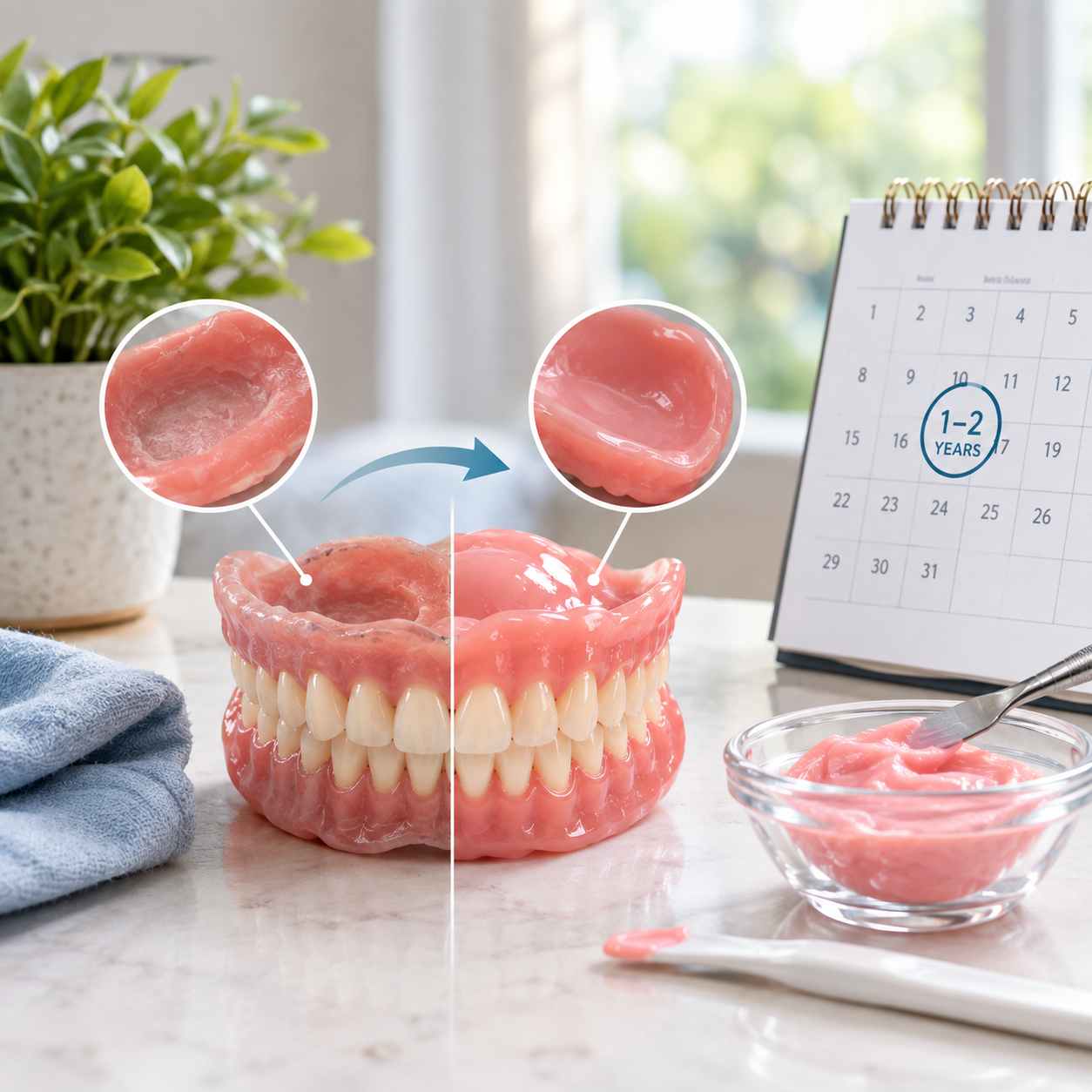
A reline adds new material to the base, fills the gap left by receded tissue, and restores the original relationship between the denture and the ridge. The denture goes back to feeling like part of the mouth rather than something just sitting in it.
8. You Go Through Adhesive Far Too Quickly
One thin application in the morning is what adhesive is designed for. If you are reapplying it after breakfast, again after lunch, and reaching for the tube before dinner, the fit has deteriorated well beyond what adhesive was ever meant to address.
Long-term overuse of zinc-containing adhesives has been associated with neurological complications in cases of consistently excessive intake. Beyond the health concern, the behavior itself is one of the clearest practical signals that a reline is well overdue, and the situation will not improve without professional intervention.
9. More Than Two Years Without a Reline
No specific event has to trigger a reline evaluation. Time alone is reason enough. Most denture wearers need a reline every one to two years simply because gum and bone tissue change on a continuous timeline that does not pause or slow down.
Three years without a reline means three years of bone change that the denture base has not kept pace with. That gap does not stay the same size; it grows. Patients who stay on a consistent reline schedule deal with far less complexity at each appointment than those who wait until discomfort forces the issue entirely.
10. You Have Started Avoiding Wearing Them
This is the sign that matters most and gets talked about the least. When dentures become something a person works around rather than something that helps them live, avoidance quietly takes hold.
Wearing dentures less frequently does not give the gum tissue a rest. It accelerates the bone loss that caused the discomfort in the first place. The ridge shrinks faster without the presence of the appliance, and each time the dentures go back in, they fit a little worse than before.
A reline resolves the source of that avoidance. Patients who have struggled with an ill fit for years consistently describe the difference after a well-done reline as significant, not just in comfort, but in confidence, social ease, and the simple freedom of eating what they want without thinking twice.
The Right Time to Act Is Right Now
Every one of these signs points to the same thing. A gap has formed between your denture and your gum tissue, and that gap does damage that compound the longer it goes unaddressed.
A denture relining is not a complicated procedure. It is a routine part of denture maintenance that keeps your appliance working, your gum tissue healthy, and your bone structure protected. The patients who do it on time stay comfortable. The ones who wait deal with bigger problems.
At New Smile Dentures, the team in Boise and Caldwell has helped patients across the Treasure Valley get that fit back without judgment, without unnecessary procedures, and without the runaround. If even two or three of these signs felt familiar, a free consultation is the smartest next step you can take.
Book yours today and find out exactly what your dentures need before things go any further in the wrong direction.
Frequently Asked Questions (FAQs)
1. What is a denture reline exactly?
A denture reline adds new material to the base of your denture so it fits accurately against your current gum tissue shape.
2. How long does a reline appointment take?
Most reline appointments are completed within the same day and typically take just a few hours from start to finish.
3. Does a denture reline hurt?
No, the procedure is completely non-invasive and does not involve injections or any discomfort during the process itself.
4. How often do dentures need to be relined?
Most wearers need a reline every one to two years, depending on how quickly their gum and bone tissue changes over time.
5. Can old dentures still be relined?
Yes, though your denturist will assess whether a reline is the right call or whether a full replacement is the better long-term option.